
Metaverse Fail? Mark Zuckerberg’s New Plan: Inside the Limitless Acquisition & The 2027 Vision
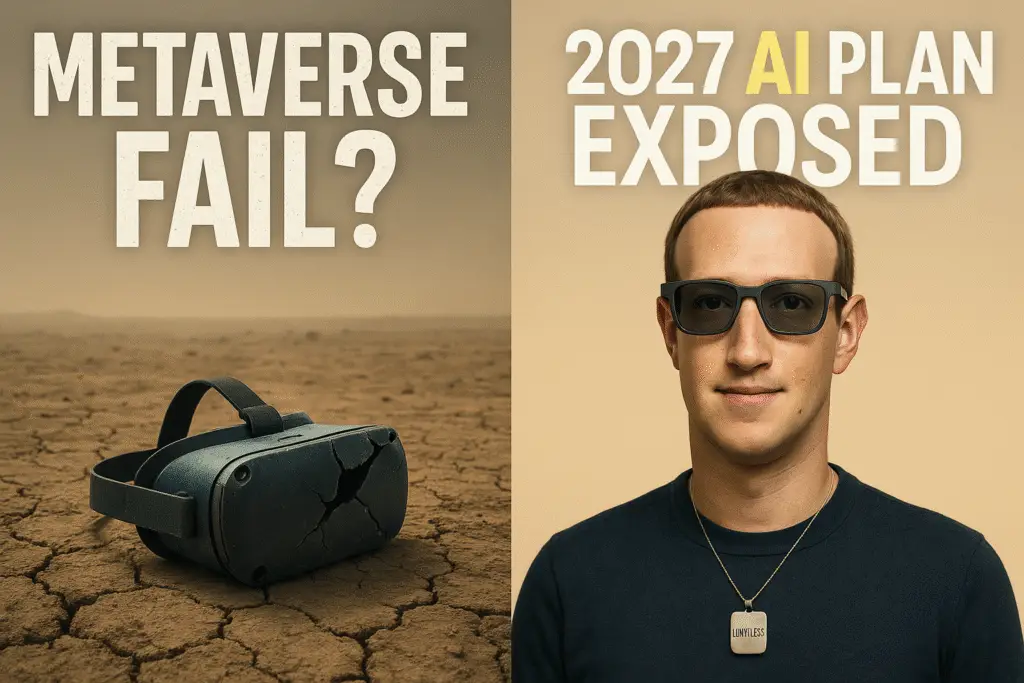
Is the Metaverse dream fading away? Meta has officially acquired AI startup ‘Limitless’ and reportedly delayed its high-end ‘Phoenix’ headset to 2027. Here is the complete technical breakdown and strategic analysis of what this means for your future.
For the last three years, the tech world has been obsessed with one word: Metaverse. But if you look closely at the headlines from Silicon Valley this week, something massive has shifted. The dream of living in a virtual cartoon world is taking a backseat. The new dream? Making humans smarter in the real world with “Super Intelligence.”
As a tech enthusiast who spends hours daily analyzing data on Gemini, ChatGPT, and Perplexity, I have noticed a gap. These AI tools are incredibly smart, but they don’t “see” what I see. They don’t “remember” my offline conversations.
That is about to change.
Breaking news confirms that Meta (Facebook) has acquired the team behind Limitless, a startup famous for its “AI Pendant.” At the same time, Meta has reportedly delayed its high-end mixed-reality headset, codenamed “Phoenix,” until 2027.
Why is Mark Zuckerberg doing this? Is the Metaverse failing? Or is this the beginning of the “Contextual AI” era? Let’s dive deep into this trending topic.
Main Title: ChatGPT 5.1 vs Gemini 1.5 Pro: 6 महीने का Honest Review – स्पीड, एक्यूरेसी और ‘Electoral Roll’ वाला टेस्ट
 Jio Pro Offer: AI की शक्ति अब आपकी मुट्ठी में! Google Gemini Pro Plan Free
1. The Limitless Acquisition: Buying a “Digital Brain”
To understand the future, we first need to understand what Meta just bought. Limitless was not just another hardware company. They created a small, wearable pendant designed to record conversations, transcribe them, and summarize them using Artificial Intelligence. It was marketed as a tool to give you a “perfect memory.”
Why did Meta buy them? Meta is likely not interested in selling pendants. According to recent reports covered by The Hindu and TechCrunch, Meta wants the talent and the technology. By integrating Limitless’s tech into the Ray-Ban Meta Smart Glasses, Zuckerberg aims to solve the biggest problem with current AI: Context.
This moves us from “Chatbots” to “Proactive Assistants.” This acquisition proves that Meta is betting big on wearables that help you in real life, rather than headsets that isolate you in a virtual room.
2. Technical Breakdown: How Will the ‘Super Memory’ Work?
You might be wondering, “How can a pair of glasses differentiate between my voice and background noise?” This is where the technical brilliance of Limitless comes in. It isn’t just a recorder; it’s a sophisticated audio processing engine.
Here is the tech stack that makes this possible:
Beam-Forming Microphones: The glasses will use an array of microphones to create a “beam” of audio focus. This technology physically isolates the sound coming from the person you are looking at, while actively suppressing the noise from traffic or a loud café.
Speaker Diarization (Voice Fingerprinting): This is a crucial AI process. The system can identify who is speaking. It separates the audio track into “Speaker A” (You) and “Speaker B” (Your Friend). It tags the conversation history with names, not just random text.
Confidential Cloud Computing (CCC): To handle privacy, Limitless developed a “Confidential Cloud.” This ensures that while the heavy processing happens on the server (to summarize long meetings), the data is encrypted so that even the company cannot access your raw audio.
Local LLM Integration: For quick tasks, a smaller Language Model (like Llama 3) will run directly on the glasses’ chip. This allows for instant summaries without needing an internet connection.
3. The “Phoenix” Delay: Why Wait Until 2027?
While Meta is speeding up on AI software, they are hitting the brakes on heavy hardware. The “Phoenix” Project was supposed to be Meta’s answer to the Apple Vision Pro—a high-end, mixed-reality headset scheduled for 2026. However, reliable sources indicate this has been pushed to 2027.
The Technical Reality
Creating a headset that is powerful enough to rival Apple, but light enough to wear all day, is incredibly difficult.
Display Issues: High-resolution screens drain the battery too fast.
The “Puck” Design: Meta was experimenting with a separate compute unit (a puck you keep in your pocket) to make the glasses lighter, but the tech needs more time to mature.
4. The Strategy War: Meta vs. Apple Vision Pro
The delay of Phoenix highlights a massive ideological battle between the two tech giants. They have completely different visions for the future of computing.
Here is a quick comparison of their strategies:
The “Isolation” vs. “Presence” Philosophy:
Apple (Vision Pro): Believes in “Spatial Computing.” They want you to wear a high-quality headset (Goggles) inside your home. It is about immersion and screens.
Meta (Smart Glasses): Believes in “Augmented Reality.” They want you to wear lightweight glasses outside. It is about enhancing your daily interactions, not replacing them.
The Ecosystem Approach:
Apple: A “Walled Garden.” They control the hardware and the software (visionOS) tightly. It is premium, expensive, and exclusive.
Meta: An “Open Approach.” Meta has released its Horizon OS to other manufacturers (like Lenovo and Asus). They want to be the “Android of AR/VR,” making technology accessible and affordable for everyone.
5. My Personal Experience: The Gap in Current AI Models
I want to share a personal observation here based on my own experiments with AI.
I use Meta AI, Gemini, and ChatGPT extensively for coding and content creation. When I ask ChatGPT to write a Python code for a “Breathing Box Widget,” it does a great job because the request is logical and digital.
But if I ask, “What was the brilliant blog idea I had while I was walking in the park yesterday?”—the AI fails. It cannot help me because it wasn’t there with me. It lacks context.
This is where the Limitless integration changes the game. Imagine wearing Meta glasses. You are walking, and you say out loud, “Note to self: Write a blog about Android 16 features.” Later, when you sit at your laptop, the AI remembers. This bridges the gap between your physical life and your digital workflow.
6. The 2027 Prediction: What Will the World Look Like?
Based on these trends, here is my prediction for the tech landscape in 2027.
A. The End of Forgetfulness
With Limitless technology embedded in glasses, the human memory will get a massive upgrade. You will never forget a name, a meeting, or a promise. The AI will act as a “backup hard drive” for your brain.
B. Total Contextual Awareness
Your glasses will use Multimodal AI (Video + Audio + Text).
Scenario: You look at a broken fan in your house.
AI Response: The glasses identify the model, find the repair manual online, and highlight the exact screw you need to turn. This is the true promise of Augmented Reality (AR).
Conclusion: A Masterstroke by Meta?
Meta’s decision to delay the bulky Phoenix headset and acquire Limitless seems like a strategic masterstroke. They are pivoting away from a niche product (VR Headsets) to a mass-market product (AI Smart Glasses).
Mark Zuckerberg realizes that the next computing platform isn’t a place you go (Metaverse), it’s a layer over the world you already live in.
As we wait for 2027, one thing is clear: The battle for your eyes and your memory has just begun. The future isn’t about escaping reality; it is about enhancing it.
What do you think? Are you Team Apple (High-end Headsets) or Team Meta (Smart AI Glasses)? Let me know your thoughts in the comments below!
Frequently Asked Questions (FAQs)
Q1: What is the Limitless AI Pendant? Limitless is a wearable device that records and summarizes meetings and conversations. Meta acquired the team behind this tech to integrate it into their smart glasses. (Internal Link Opportunity: Link to your article about “Meta’s AI Hardware Plans”)
Q2: When will the Meta Phoenix headset be released? Reports suggest the high-end Phoenix mixed-reality headset has been delayed until 2027 due to technical and budget challenges. (Internal Link Opportunity: Link to your article about “Meta’s Mixed Reality Headset Roadmap”)
Q3: Is the Metaverse dead? Not dead, but deprioritized. Meta is shifting focus from immersive VR worlds to AI-driven Augmented Reality (AR) wearables. (Internal Link Opportunity: Link to your article about “The Future of AR/VR”)